American Food
I still remember the scent of the charcoal grills lining the streets of Hatsukaichi. I was back in my birthplace, searching for fragments of a story I hadn’t lived, feeling a bit like a stranger in a familiar-looking skin. My side braid was slightly windsweled, and my favorite red lipstick was definitely a bit smudged from a morning spent exploring temples. I stopped at a small stall where an elderly man was grilling thick, woody shiitake mushrooms over white-hot binchotan coals. He handed me one on a simple wooden skewer, brushed only with a whisper of soy sauce.

That first bite changed everything for me as a chef. It wasn’t just “good for a vegetable”—it was deep, resonant, and remarkably substantial. It had a weight on the tongue that I’d previously only associated with the heavy, savory stews my dad, Edward, used to make back in Ohio. It was the moment I realized that being vegan didn’t mean walking away from the “soul” of a meal; it meant finding that soul in the most unexpected places. That mushroom didn’t just taste like a plant; it tasted like history, like the earth, and like a secret I was finally being let in on.
The secret, as I would later learn in culinary school, is a little something called umami. We’re taught about sweet, salty, sour, and bitter, but umami is that elusive “fifth taste.” It’s a Japanese word that translates roughly to “pleasant savory taste,” and it’s all thanks to an amino acid called glutamate. Mushrooms are absolute powerhouses of these natural glutamates. When we talk about something tasting “meaty,” we aren’t necessarily talking about the animal itself; we’re talking about that specific chemical signal that tells our brains we’re eating something nutrient-dense and satisfying.
In my NYC kitchen, while some old school hip hop plays in the background, I often think about how this science bridges the gap between the traditional Japanese flavors of my birth and the hearty Midwestern comfort of my upbringing. When I’m searing a batch of mushrooms, the kitchen fills with a scent so rich that even Zelda, my Berlin-born Boston Terrier mix, starts pacing the floor with her tail wagging. She’s a street-smart girl who knows a good thing when she smells it! It’s that glutamate magic that creates a bridge between cultures, proving that the craving for depth and “meatiness” is a universal human experience that doesn’t require animal products to satisfy.
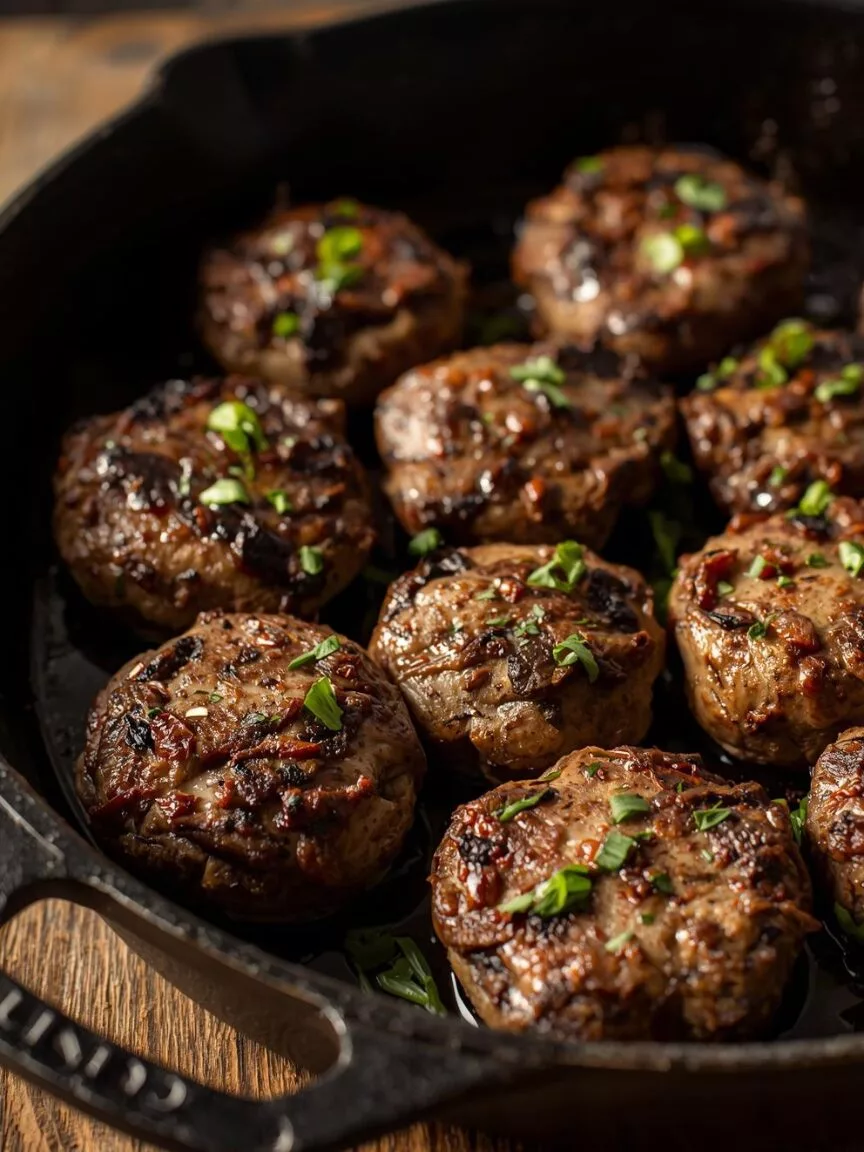
To get that “steak-like” vibe, you have to treat your fungi with a bit of respect and a lot of heat. My absolute favorite technique is the “press and sear.” Most people make the mistake of crowding the pan or moving the mushrooms around too much, which just leads to them steaming in their own liquid. You want to drive that moisture out to concentrate the sugars and proteins. I like to use a heavy cast-iron press—or even another heavy pan—to physically flatten them against the hot surface. This creates a crust that is insanely crispy and packed with concentrated flavor.

I recently hopped on a video call with my brother, Naveen, who’s out in LA. He was telling me about a new skincare line he’s developing, but our conversation eventually drifted, as it always does, to food. I told him he needed to try pressing King Oysters until they look like scallops. It’s about more than just cooking; it’s about the intention behind the heat. When you roast mushrooms at a high temperature, like 425°F (220°C), you’re initiating the Maillard reaction—that beautiful browning process that creates complex new flavor compounds. It’s the same process that makes toasted bread or roasted coffee taste so much better than the raw versions.
Cast Iron Pressed “Steak” Mushrooms
Ingredients
- 1 lb 450 g king oyster or large portobello mushrooms
- 2 tablespoons 30 ml avocado oil or neutral oil
- 1 tablespoon 15 ml tamari or soy sauce
- 1 teaspoon agave syrup
- 1 teaspoon smoked paprika
- 2 cloves garlic smashed
- 1 sprig fresh rosemary
- 1/2 teaspoon sea salt
- 1/4 teaspoon black pepper
- 1 tablespoon 8 g all-purpose flour (optional, for extra crust)
Instructions
- Prep the mushrooms: Clean the mushrooms with a damp cloth. If using king oyster mushrooms, slice them lengthwise into about 1-inch (2.5 cm) thick “steaks.” If using portobellos, remove the stems.
- Make the marinade: In a small bowl, whisk together the oil, tamari, agave syrup, smoked paprika, sea salt, and black pepper.
- Season the mushrooms: Brush the mixture generously over both sides of the mushrooms. For extra crust, lightly dust with flour.
- Heat the skillet: Place a large cast-iron skillet over medium-high heat until very hot.
- Press and sear: Add the mushrooms to the pan in a single layer. Place a second heavy skillet (or foil-wrapped brick) on top to press them down. Sear for 4–5 minutes without moving them.
- Flip and finish: Remove the weight, flip the mushrooms, and add the smashed garlic and rosemary to the skillet. Replace the weight and cook for another 4 minutes, until deeply browned and reduced in thickness.
- Serve: Slice thinly and serve in warm tortillas with lime slaw, or alongside roasted vegetables or mashed potatoes.
Notes
Nutrition
Mastering the mushroom vibe has become my way of staying connected to my roots while living my truth as a vegan chef. Every time I hear that sizzle in the pan, I’m transported back to that charcoal grill in Japan, but I’m also right here in my NYC apartment, carving out a new path. It’s a way of honoring my biological heritage and the culinary traditions I’ve gathered along my travels, from Jamaica to India. Food is a language, and umami is one of its most powerful dialects.
Whenever I’m feeling a bit overwhelmed by the pace of the city, I’ll roll out my yoga mat on the fire escape for a few minutes, then head straight to the kitchen to sear some mushrooms. There’s something so grounding about the process—the heat, the weight of the cast iron, the transformation of a simple forest dweller into something spectacular. It reminds me that we are all a product of our environments and the heat we endure, turning into something richer and more complex as we go. It’s a lesson I carry with me, etched just as clearly as the Thai tea set tattoo on my arm.
If you enjoyed this recipe or have suggestions on how we can improve it, please leave us a comment below. Also, make sure to check out other dishes I’ve created or stories I’ve written about food culture – here.